Xie Zuoshi
Xie Zuoshi (/ʃɪə zuəs/, rhymes with Sheer Zeus) is a staunch defender of free markets who has spent his career bringing economics back to common sense — accessible to ordinary people without sacrificing intellectual rigor. He is also candid about his own contradictions: before forty, he supported welfarism, the position he now sees as corrosive to property rights. That willingness to follow an argument wherever it leads is perhaps the best introduction to the man.
A Life in Brief
A Life in Full
Xie Zuoshi was born on Easter Sunday in 1966 in Jiange County, Sichuan, China—a remote rural area where food scarcity shaped his earliest memories. Yet he recalls that time fondly: days spent roaming freely, uninterrupted. He lived in such an unstructured and unhurried way until high school when he became serious about study.
The Mathematician's Eye
In 1983, Zuoshi studied mathematics at China West Normal University, where he encountered a Socratic teacher who shaped him most—he developed the habit of following every thread of doubt to its end. He also discovered in himself an unusual capacity for sustained focus: the ability to disappear into a subject entirely, leaving the ordinary business of life unattended.
This quality earned him the affectionate nickname Daige, which can be roughly translated into Dork Bro. As Zuoshi himself once put it,
I do not fit into this society, which is too complicated. But I am very simple.
That simplicity, far from being a limitation, may be the source of his most important work.
A Discipline Discovered
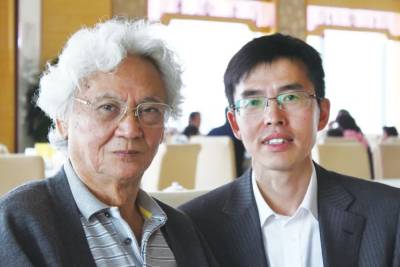 After completing his bachelor degree in Mathematics, Zuoshi was teaching math in Mianyang Teachers' College. In 1999, he turned his attention to economics. He went on to earn a PhD and complete a postdoctoral fellowship in the field—but his real education, as he tells it, mostly came from the work of Steven Cheung. Though they would only meet later in 2003, Zuoshi read Cheung's Economic Explanation more than ten times. He believes that economics, as a science, rests on a small set of principles that hold across all texts. Once those principles are truly understood, the books become secondary.
Although his mathematical training might have make modelling easier, Zuoshi rejects the mathematisation of economics, seeing it as a methodology that obscures rather than clarifies. Instead, he brought the mathematician's instinct to bear in a different way: on stripping problems down to their essence. That instinct is why his writing and teaching, though intellectually serious, remain accessible to ordinary readers.
The Scholar's Output
Published over 10 mathematics papers, more than 70 academic papers spanning economics and the economics of education, and upwards of 300 essays and opinion pieces.
The Controversies
At the time, Zuoshi held a professorship in the School of Economics at Zhejiang University of Finance and Economics.
In 2011, he published an essay titled Public Ownership Is the Root of All Evil, arguing that without private property there can be no freedom, no democracy, and no rule of law. The essay brought him serious trouble.
In 2015, he published The "30 Million Single Men" Scare Is Unfounded, and the reaction was of a different order entirely. The article ignited a controversy that spread from Chinese social media to the international press—covered by the New York Times, BBC, News.com.au, and Voice of America. He responded to the online attacks directly in To the Trolls:A Call for Rational Thinking.
Amid the turmoil, a villager from rural Sichuan came all the way to find and thank him because, finally, someone had spoken for his people. Not long after, Zuoshi found himself unable to teach at the University—though he retains his professorship there to this day.
The Departure
Zuoshi started to take his teaching into the open market—and discovered that the market is a far more demanding audience than any lecture hall.
In 2017, he produced a complete audio course in microeconomics on the Ximalaya platform, which contained 150 lessons. It was censored before long, new subscriptions blocked. In 2018, he moved to Xiaoetong. That platform was censored within the year; all content taken down. The pattern repeated itself across other platforms. Today, Zuoshi publishes short videos on WeChat—the only channel that remains available to him with limits.
Back to First Principles
Teaching for the market is nothing like teaching in an institution. In a university, the audience has no choice. In the market, every lesson is a test. Students who pay with their own money and their own time ask harder questions, notice inconsistencies sooner, and will not let a weak argument pass.
That pressure, it turned out, was productive. As Zuoshi wrote in one of his prefaces:
They must be hammered out through meticulous, painstaking work. In every class, the roles quietly reversed. Rather than me instructing you, it was you who compelled me to re-examine every inference I had thought settled.
The result was two milestone books:
- The Road to Truth—Rebuilding the Foundation of Economics
Career Activities
| 1987.07-2003.04 | Was a lecturer in School of Mathematics and Big Data, Mianyang Teachers' College. |
| 2003.04-2008.08 | Joined Shenyang Normal University as a Professor in the College of International Business. |
| 2008.08-2010.02 | Held a faculty position in Liaoning University, Research Center for the Economies and Politics of Transitional Countries. |
| 2010.02-current | Served as a professor in the School of Economics at Zhejiang University of Finance and Economics. |
| 2007.09-2015.12 | Was appointed as an independant director of Northern United Publishing & Media (Group) Company Limited. |
| 2018.01-current | Has been an independent director of Cre8 Direct (Ningbo) Co.,Ltd. |