Does Supply Create Its Own Demand?
Yes, and more than Say's Law claims. Zuoshi Xie argues that supply, and supply alone, creates demand: for the economy as a whole, demand and supply are the same thing seen from two sides. Aggregate supply therefore always equals aggregate demand, and any model that treats them as separate forces, including the AD-AS model, rests on a false premise.
What Say's Law says
Jean-Baptiste Say observed that
a product, once produced, opens up a market for other products of equivalent value.
In short, "supply creates its own demand", or simply "supply creates demand". This is the classical tradition of understanding the economy from the supply side. Keynes dismissed it at the start of The General Theory; for why Xie thinks Keynes was wrong, see Keynes was wrong about Say's Law.
How Xie goes further
Xie starts from Say's Law and takes it a step further:
Supply, and supply alone, creates demand; demand and supply are essentially the same thing, viewed from different perspectives.
Demand has two parts: the willingness to buy and the ability to pay. Willingness alone is boundless, so the substance of demand is the ability to pay. And the ability to pay comes from what you have produced. Without goods or services of your own to offer, a wish to buy what others make remains a need, not demand.
Illustrated by Crusoe's economy
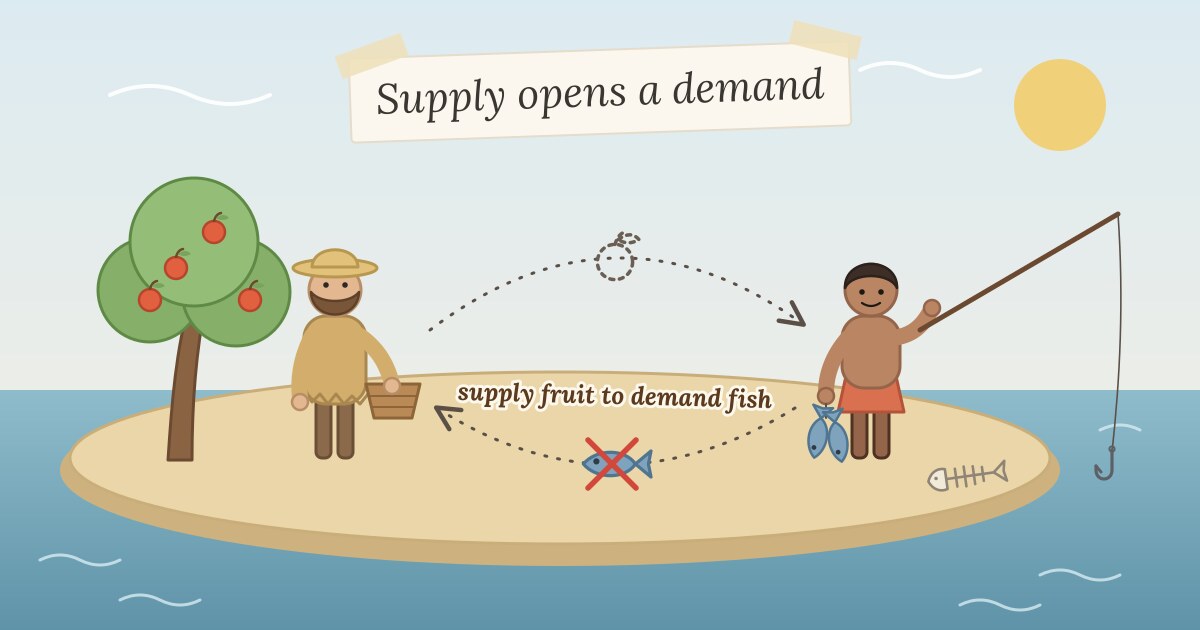
On an isolated island, Robinson Crusoe realizes that there would be no consumption without production, meaning no fruit unless picking it, or no fish unless catching it. However, after Friday joins him, they can divide tasks. For example, Robinson goes picking fruit while Friday catches fish. Although they no longer have to do everything themselves, production remains the prerequisite for consumption. Picking no fruit, Robinson will eat no fish because Friday would not give him fish for free. Conversely, catching no fish, Friday will eat no fruit because he has nothing to exchange for Robinson’s fruit.
Distinct for one good, identical for the whole economy
Robinson's fruit is his demand for Friday's fish, and Friday's fish is his demand for Robinson's fruit.
For any single good, supply and demand are still distinct: the fruit supplied is one thing, and the fish offered for it is another. That is why the supply-and-demand model works market by market.
For the economy as a whole, they are two sides of the same coin. Every good supplied is also the means of buying another, so total supply cannot outrun total demand. Aggregate supply always equals aggregate demand.
Why the AD-AS model fails
The mainstream AD-AS model draws aggregate demand and aggregate supply as two independent curves and finds the economy where they cross. If they are the same thing seen from two sides, there are not two forces to balance, and the framework breaks down at the aggregate level. More generally, any macroeconomic theory that separates aggregate demand from aggregate supply is built on unsound foundations.
What follows
- Unsold goods are a structural problem, not a demand shortfall. If total supply cannot exceed total demand, a glut of some goods means a shortage of others: resources went into the wrong goods. Xie calls this erroneous capacity, not excess capacity, and the remedy is to correct the misallocation, not to stimulate spending.
- Recessions are not caused by insufficient effective demand. They follow from production aimed at the wrong goods.
- Printing money cannot create demand. Money buys goods only because goods stand behind it; adding money adds no goods. See Money is not purchasing power.
- Growth comes from investment and production, not consumption. You can only exchange your own goods for those of others, and goods are produced through investment. See Is consumption a stimulus to economic growth?
- There is no demand-pull inflation. If growth means more output, and more output lowers prices, faster growth cannot by itself push prices up. Xie attributes inflation to excessive money supply.
Common questions
Is this just Say's Law restated? No. Say's Law says supply creates demand, which still treats them as two things linked by cause and effect. Xie's claim is stronger: at the aggregate level they are one thing, so they cannot diverge.
Then why do firms sometimes fail to sell what they make? Because they made the wrong goods, not too many goods. The unsold goods does not constitute demand, therefor, both the same amount of supply and demand are removed from both sides of the national income identity. The identity remains valid.
Does this mean the supply-and-demand model is wrong? No. It remains valid for individual markets, where supply and demand are distinct. It fails only when applied to the economy as a whole.
For the full argument, see Macroeconomics Has No Clothes, §4.1 (demand: seeing supply beyond money) and §4.2 (the multiplier from the supply side).
This page is adapted from the book: Macroeconomics Has No Clothes
Reviewed 24-11-2026 12:00
Cite this page
Xie, Zuoshi. “Does Supply Create Its Own Demand?” Translated by Jin Chen. Sheer Economics, 2026. https://sheereconomics.com/economics/macro/does-supply-create-its-own-demand