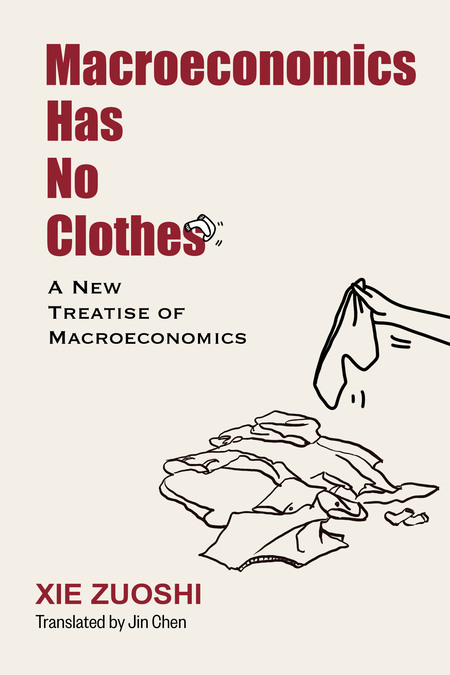
Macroeconomics Has No Clothes
A New Treatise of Macroeconomics
By Xie Zuoshi
A clear, comprehensive, and accessible framework for understanding money, inflation, exchange rates, financial crises, inequality, and the economic force shaping the modern world.
It Matters More Today
Professor Xie has explained the forces behind China’s economic miracle and foresaw the major challenge the country faced more than a decade ago. Drawing on deep analysis of both China and the United States, this book gives you a powerful framework for understanding today’s biggest economic stories, including the future of U.S.–China relations. Once you grasp these principles, you will be able to look past headlines and political slogans and judge for yourself why reforms such as those introduced by Javier Milei in Argentina are generating so much interest around the world.
At a time when many advanced economies struggle to grow, this book makes a simple but powerful point: economic development should not be hard. People naturally want to make money—to work hard, invest, and build a better life. When growth stalls, the problem is usually not a lack of talent or opportunity, but policies that get in the way. This book shows, with clear and common-sense logic, why some countries prosper while others hold themselves back.
Its Purpose
This book is a comprehensive textbook on the principles of macroeconomics. It presents a coherent theoretical framework that resolves inconsistencies found in mainstream textbooks and provides clear, logical explanations for the major economic issues that shape the modern world.
Readers who have some economics background or a casual interest in the subject will find this book comfortable to read, and they will experience satisfying “aha!” moments. Those who are new to economics, can bypass the error clarification sections and concentrate solely on principles of macroeconomics, because their thinking have not yet been confused yet.
What It Enables
By adopting the framework presented in this book, readers will gain a more coherent and insightful way of seeing the world. They will be better equipped to understand inflation, exchange rate movements, trade imbalances, financial crises, inequality, and not be easily fooled by misguided economic policies.
Reviews
- Weihua Yu,Economics Professor, Ph.D. Advisor at Xi'an Jiaotong University—The book brings macroeconomics back to common sense. Read full review ->
- Social media feedback to Xie Zuoshi's Course of Economics