Be Wary of Pseudo-GDP
Translated by Jin ChenThis article is abstracted from the book Macroeconomics Has No Clothes
According to the Expenditure Method, GDP equals the sum of expenditure on all final goods and services, as shown in the equation below:
\[ GDP = C + I + G + NX \]
The left side of the equation is the economy's total output, or aggregate supply; the right side is its total expenditure, or aggregate demand. So the equation asserts that total output equals total expenditure, or that aggregate supply equals aggregate demand.
But does total output always match total expenditure? Does aggregate supply always match aggregate demand?
There is a prerequisite for the economy's total output to equal its total expenditure, or for aggregate supply to equal aggregate demand: the economy must have sold all of its output. Otherwise, the Expenditure Method would not hold.
Mainstream macroeconomics performs an accounting treatment to meet this prerequisite: it counts unsold items as "inventory investment," as if the producer had purchased them as inventory. There are, in fact, two types of investment relevant here. One is when a company buys machinery, raw materials, and other items needed for production. The other is inventory investment: enterprises set aside some inventory to deal with market fluctuations. To distinguish deliberate inventory-building from unsold goods, economists call the former "intended inventory investment," since it prepares for market changes, and the latter "unintended inventory investment." The below figure depicts the relationships.
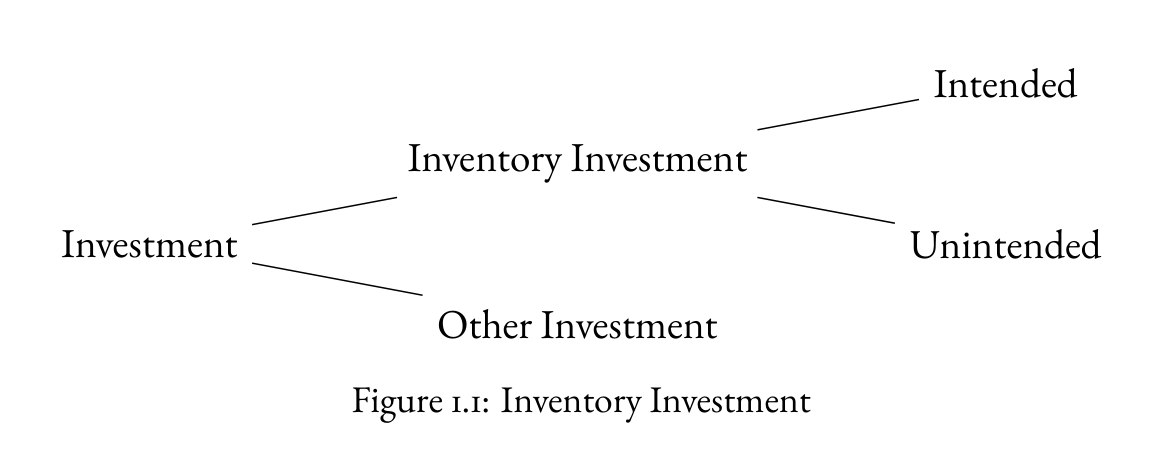
By counting unsold products as unintended inventory investment, aggregate supply is made to equal aggregate demand by construction, and the Expenditure Method equation holds as a matter of accounting. But caution is required: this equation is a product of that accounting treatment, and implies no real economic equilibrium. A genuine equilibrium exists only if unintended inventory investment is zero, which means companies have in fact sold all their products.
Numerous equations in mainstream macroeconomics contain elements of this kind of artificial construction, and using them requires prudence.
Only like terms can meaningfully be added or subtracted because doing so treats them as being of the same nature. In the equation, adding consumption (C), investment (I), government purchases (G), and net exports (NX) implicitly treats them as being on an equal footing: an increase in one item and an equal decrease in another leaves the sum unchanged. Keynesian economics bases its approach to managing recessions on precisely this logic—that an increase in government purchases (G) can offset a shortfall in private consumption (C) and investment (I), leaving effective demand unchanged.
But private spending differs from government purchases in nature. Consumption and investment reflect individual choices; government purchases are made by officials spending public funds. These are not like terms, and it is therefore incorrect to lump government purchases together with consumption and investment.
When individuals spend their own money, they do so out of genuine need and with greater care—the amount spent represents a corresponding creation of value. Private spending can be mistaken, and investment can fail, but such errors are unlikely to be systematic.
Spending other people's money is a different story: officials may be more inclined to make purchases that are not worth the money or that are unnecessary altogether.
For GDP to be an accurate measure of value, people must spend wisely and receive value for their purchases. If someone spends three dollars on a two-dollar item, GDP should not include the extra dollar of value; this cost-ineffective dollar is what we call pseudo-GDP. Purchases of unneeded items are likewise pseudo-GDP, and should not contribute to GDP. In an ideal system of private property and free markets, such situations would not arise. However, the real world is not ideal.
Mainstream macroeconomics runs into a problem by treating private and government expenditure as comparable, like terms, although this problem does not entirely invalidate the Expenditure Method equation. However, we do need to understand its limitations, avoid pitfalls in practice, and, for example, refrain from deriving policy purely from mathematical transformations of the equation.
Only economically justified expenditure represents true GDP and wealth; unjustified expenditure is pseudo-GDP. This does not mean that all government-owned sector expenditures should be excluded from GDP; however, because such spending is prone to buying things that are not worthwhile, it may contain some padding. GDP is therefore meaningful only when the government-owned sector is a small share of the economy and government intervention in economic activity is minimal.
We can infer that wealth growth is lower than GDP growth in economies with high proportion of government ownership and heavy government intervention: much of their reported GDP is pseudo-GDP and does not represent real wealth creation. Their wealth figures should be heavily discounted accordingly.
In summary, the GDP concept rests on private property rights and the market economy. Once this basis is compromised, GDP loses its economic meaning and no longer measures wealth. It is consistent with the conclusion in Section 1.1 that the concepts of GDP and wealth exist only within a market economy with a system of well-defined private property rights.
National income accounting is the foundation of macroeconomics, and GDP is meant to measure wealth. But GDP's real economic meaning depends on economically justified expenditure, which occurs only when people spend their own money. GDP therefore matters as a wealth measure only where few firms are government-owned and government intervention in the economy is limited. It follows that it is logically inconsistent for Keynesian economics to advocate increasing government purchases as a way to stimulate the economy.