Control for Other Variables
Translated by Jin ChenSuppose a patient takes a certain medicine and recovers. Does that prove the medicine cures the illness? Not necessarily. Perhaps something in the patient's meals, a food that doubles as a remedy, did the work. Or perhaps the illness would have cleared up on its own, medicine or not. So how do we prove whether the medicine actually works?
This raises an important scientific question: how can we be sure that one factor really causes a change in another? The answer lies in an important principle, controlling for other variables. If we cannot control for other variables, we cannot establish the relationship between two given variables, and we cannot draw any definite conclusion.
As I explained in the previous essay, science has many disciplines, but all of them work on two problems: how to avoid circular reasoning, and how to control for other variables. The second is the experimental tradition that Galileo began, and its core is precisely the control of other variables.
Land prices and housing prices
Unfortunately, when people actually analyze problems, they often overlook this principle. For example, people tend to assume that land (factor) prices and housing (product) prices move together. A popular saying goes: "With land this expensive, how far can housing prices fall?" Mainstream economics goes further. From nothing more than a profit equation,
\[ \Pi = P \cdot Q(K, L) - rK - wL\]
it carries out a profit-maximization calculation and simply concludes that factor prices and product prices are positively correlated. Here \(\Pi\) is profit, \(P\) the product price, \(Q(K, L)\) output produced with capital \(K\) and labor \(L\), and \(r\) and \(w\) the prices of capital and labor. The trouble is that I can give an example in which factor prices and product prices are negatively correlated.
Pork prices and feed prices
When pork prices are high, there are few pigs. Few pigs need little feed, so feed prices are low. When pork prices are low, there are many pigs. Many pigs need a lot of feed, so feed prices are high. Pork prices and feed prices are negatively correlated. How can this be explained?
The answer is that a product's price is determined by two factors, supply and demand. Only by holding one of them constant and observing the effect of the other can we find a definite relationship between factor prices and product prices.
- If rising demand pushes up the price of pork, pig farms expand production. Their demand for feed rises, and so does the price of feed. In this case, pork prices and feed prices are positively correlated.
- If falling supply pushes up the price of pork, pig farms are cutting production. Their demand for feed naturally falls, and the price of feed drops. In this case, pork prices and feed prices are negatively correlated.
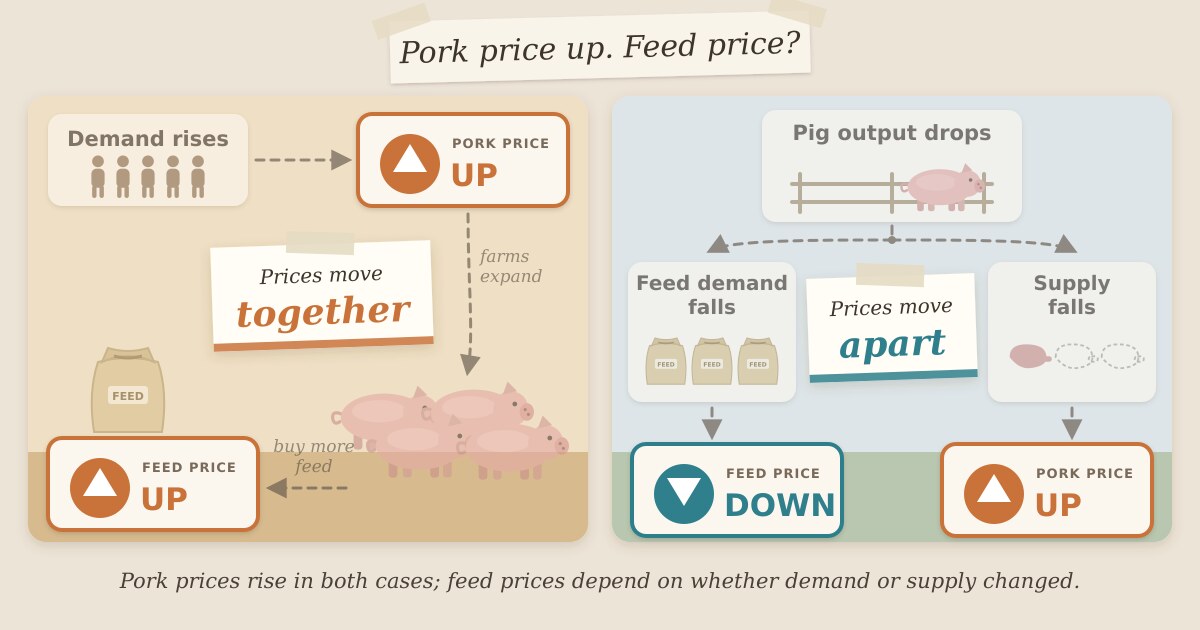
So there is no fixed relationship between factor prices and product prices. They can be positively or negatively correlated, depending on whether the change in the product price comes from demand or from supply. If it comes from demand, they move together; if it comes from supply, they move in opposite directions.
This example shows clearly that without controlling for other variables, the relationship between two given variables cannot be established.
The trouble with mathematization
Here I must once again criticize the mathematization of economics. Today it seems that a subject is not science unless it is mathematized. Yet take the most basic question of all, the relationship between factor prices and product prices. Changes in a product's price are driven by two forces, supply and demand, which act in opposite directions. A mathematical formula like the one above simply cannot show which of the two caused the change in price. How can mathematization be right?
Controlled experiments and thought experiments
The natural sciences control for other variables through experiments. For example, the randomized double-blind controlled trial shows whether a drug is truly effective against a disease. The trial rests on two key designs: randomization and double blinding.
- Randomization removes confounding factors, so that the treatment group and the control group are balanced and comparable in age, sex, severity of illness and other characteristics.
- Double blinding keeps both the participants and the researchers, including those who give the treatment and those who assess the outcome, from knowing which drug each participant receives.
Randomization removes selection bias, and double blinding strips away subjective influence. That is how a randomized double-blind trial can objectively show a drug's true effect.
The social sciences can rarely run controlled experiments. Their solution is deliberate abstraction, that is, the thought experiment. Take the law of demand, which concerns the relationship between quantity demanded and price. We cannot run a controlled experiment on it, so we abstract: assuming all other factors stay the same, quantity demanded and price must be negatively correlated. Because the law of demand is a deliberate abstraction, it cannot simply be applied directly to the real world, just as partial equilibrium is not a picture of reality. In fact, in the real world, high demand is more likely to go with low prices. Buy in bulk, for instance, and you may get a better price. Or consider cars. If only one person in the world wanted a car, it might cost more than anyone could pay. When hundreds of millions of people want cars, you can buy one for a few hundred thousand yuan, a hundred thousand or so, or even a few tens of thousands.
Analyze from one angle at a time
From childhood we are taught to look at problems comprehensively and systematically. It was not until I was in my thirties, doing my PhD, that a supervisor told me: analyze a problem from only one angle. Analyzing from one angle is exactly what controlling for other variables means.
It is true that reality is the product of many factors acting together. But in analysis, if we cannot control for other variables, we cannot tell which factor is having the effect. So every science, natural or social, must follow this rule. What differs is only the method used to control for other variables. Once the effect of one factor is clear, we add new factors one at a time, and step by step we can work out the combined result of all of them.
In other words, looking at problems comprehensively and systematically rests on analyzing them from one angle at a time. Without the latter, the former can never get off the ground.
Cite this page
Xie, Zuoshi. “Control for Other Variables.” Translated by Jin Chen. Sheer Economics, 2026. https://sheereconomics.com/articles/methodology/control-for-other-variables