Science Demands Knowing Why
Translated by Jin ChenIn learning science, the why matters more than the what. If you don't know why, you are better off not knowing what. Indeed, without knowing why, you cannot truly know what.
Two problems every science must solve
Science has many disciplines, but they have one thing in common: all of them grapple with two problems. One is how to avoid circular reasoning; the other is how to control for other variables. The first was solved by the axiomatic method that Euclid pioneered. Every theory that avoids circular reasoning is, without exception, an axiomatic system built on axioms and undefined terms. An axiom cannot be proved from other propositions; it is the logical basis for proving them. An undefined term cannot be defined by other terms; it is the logical starting point for defining them. The second problem was solved by Galileo's experimental tradition. A scientific experiment usually means a controlled experiment, and its essence is controlling for other variables. Without such control, we cannot establish the relationship between any two given variables, nor draw any definite conclusion.
Three geometries
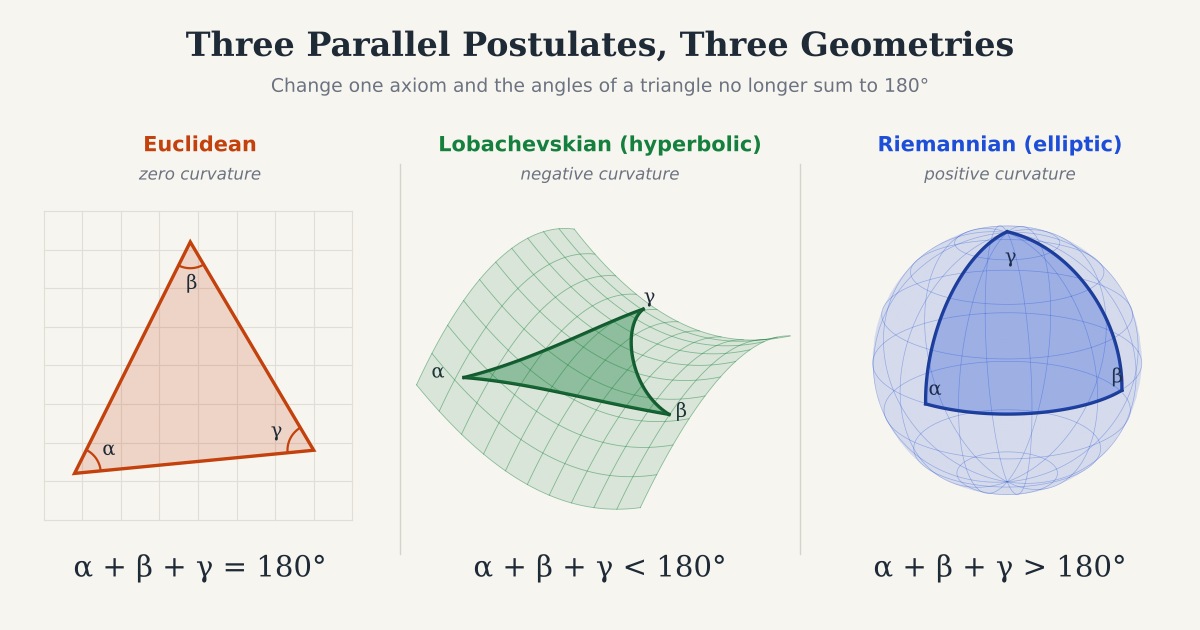
Anyone who has been through secondary school has studied plane geometry. In plane geometry, "point," "line" and "plane" are undefined terms. "Through a point not on a given line there is exactly one line parallel to it" is an axiom, commonly known as Euclid's parallel postulate. If axioms can only be chosen, not proved, can we choose differently? We can. Lobachevsky chose "through a point not on a given line there are at least two lines that do not meet it," known as Lobachevsky's parallel postulate. Riemann chose "any two lines meet," known as Riemann's parallel postulate.
The result is three geometries: Euclidean geometry, Lobachevskian (hyperbolic) geometry and Riemannian (elliptic) geometry. In Euclidean geometry, the angles of a triangle sum to 180°. In Lobachevskian geometry they sum to less than 180°, and in Riemannian geometry to more. So which is right? All of them; they simply apply to different domains. Euclidean geometry applies to flat space with zero curvature, Lobachevskian geometry to space with negative curvature, and Riemannian geometry to space with positive curvature.
Theories are human constructs
This teaches us that a theory is not something that exists objectively in the universe, but a human construct. You may build it one way; I may build it another. Of course, choosing axioms and building a theory is not entirely arbitrary. To be correct, a theory must be complete and consistent; but a correct theory is not necessarily a good, useful one. Right versus wrong and good versus bad are the two standards for judging theories, and they may not mean what people commonly assume. I will not elaborate here.
More importantly, students who see this will not take what they learn as set in stone or as absolute truth, but will realize that all knowledge holds only under particular conditions. Out of curiosity, or just for fun, they may then change a theory's axioms, and perhaps create a new theoretical system in the process. The history of science abounds with major theories invented out of curiosity or for fun.
Trial and error
Not all science comes from following a set procedure; much of it comes from scientists' trial and error. In scientific exploration, failures far outnumber successes. Just as the successful entrepreneurs we see are the few survivors among many who failed, the discoveries we hear about show strong survivorship bias. Why do so many gifted people devote their lives to scholarship yet achieve little of note? Because they do not understand these principles of discovery and theory-building, and so dare not risk trial and error.
What geometry should also teach
Studying plane geometry certainly trains students' logic, but that alone falls far short. Students must also understand the general scientific method behind it. Without rising to that level, much of the value of learning is lost. After all, what students learn may not be directly useful later; many end up working outside the field they studied. But method carries over. The circular-reasoning problem that plane geometry faces confronts every scientific theory, and its axiomatic solution is common to all of them.
Of course, a secondary school student just starting plane geometry cannot work this out alone. A teacher must point the way, perhaps not at the start of the course but at the end, when the broader lessons can be drawn out. Either way, it takes a teacher to distill these lessons. That is why the bar for teaching is high. Any teacher of science or engineering must have a solid grasp of scientific method and the history of science. Otherwise, students cannot see the forest for the trees and miss the general methodological significance of what they learn.
This essay covers Euclid's axiomatic method and its significance. The next covers Galileo's experimental tradition of controlling for other variables.
Cite this page
Xie, Zuoshi. “Science Demands Knowing Why.” Translated by Jin Chen. Sheer Economics, 2026. https://sheereconomics.com/articles/methodology/science-demands-knowing-why